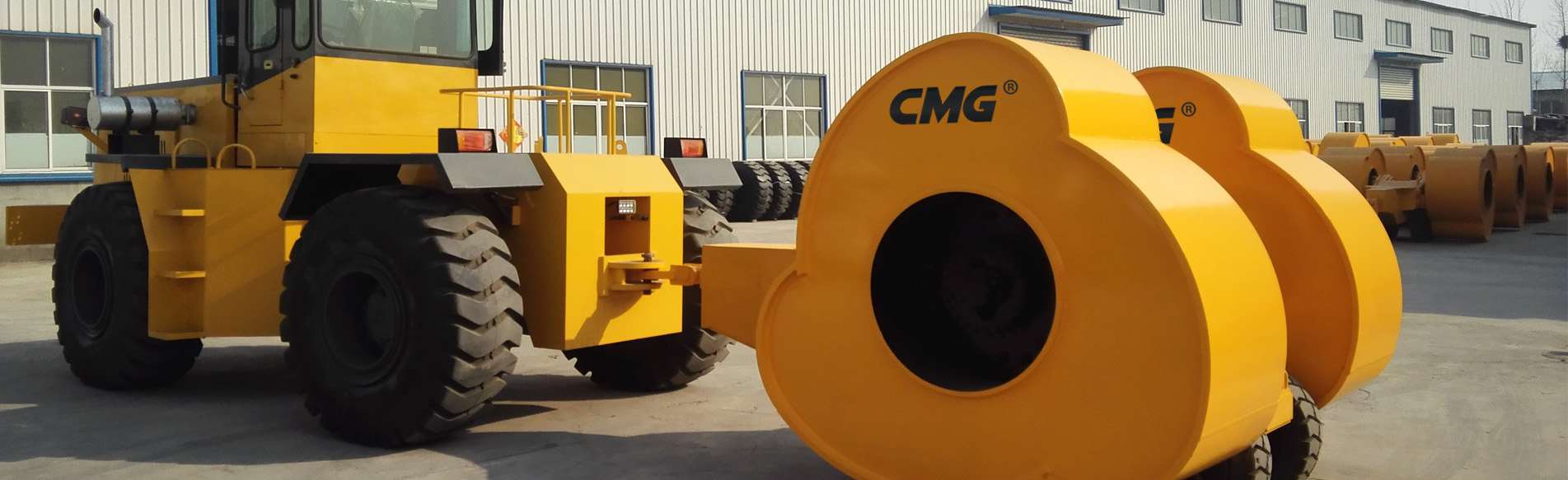
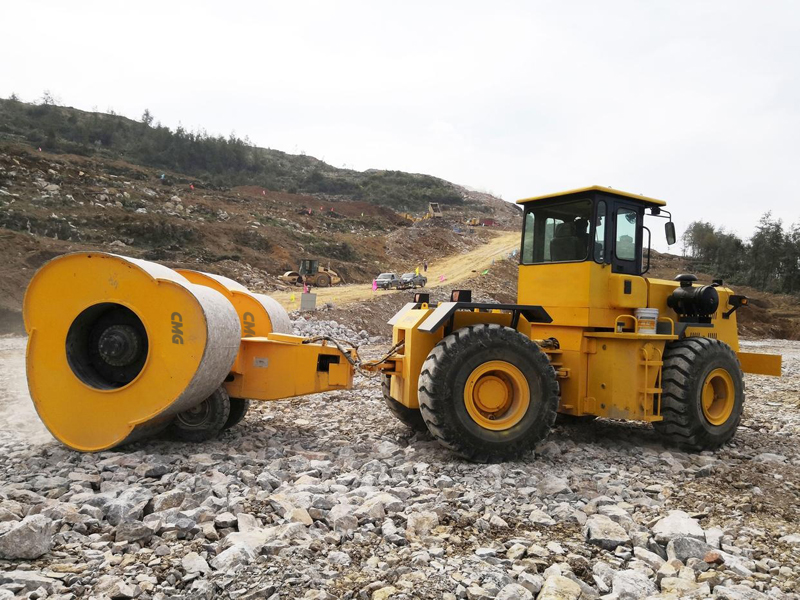
High-energy impact compaction — usually shortened to HEIC — is ground improvement carried out with a towed, non-circular drum that delivers repeated high-energy blows to a fill at depth. It is a deep treatment applied from the surface: no excavation, no replacement, no imported stone. The drum simply works the material where it has been placed.
What the method actually does
The drum is drawn across the fill at working speed. Each corner-to-face drop delivers a blow; the sequence of blows, spaced along the direction of travel, produces a grid of stressed zones that overlap as passes are repeated. Within those zones the fill densifies, voids collapse and the surface settles. Because the energy is delivered below the surface rather than only at the contact, the effect extends deeper than a layer-by-layer roller can reach in a single operation.
How it differs from a vibratory roller
A vibratory roller compacts by applying a rapidly oscillating load to a thin layer, and its influence is largely limited to that layer. Its performance is tied to strict layer thickness control, usually a few hundred millimetres. HEIC applies discrete, much larger blows to a thicker body of fill. The comparison is not "better or worse" but "different depth and different production logic": the vibratory roller builds a layer, the impact drum treats a mass.
How it differs from other deep methods
Deep improvement has several families. Dynamic compaction drops a weight from a crane on a grid; it is discontinuous, crane-bound and grid-driven. Vibro compaction and stone columns introduce a probe and, usually, imported material. Dynamic replacement excavates and replaces soft ground with stone. HEIC is continuous and mobile: one tractor and one drum work across the area, and the same machine can move to the next plot without a crane or a probe rig. That mobility is its main commercial advantage on large, spread-out sites.
Ground that responds well
The method earns its place in uncontrolled and variable fill, hydraulic and dredged fill, colliery and mining spoil, weathered and decomposed rock, and rockfill where the matrix between the large particles needs densifying. It is also used to collapse the voids in fills that have been placed loose and deep, and to accelerate settlement in compressible fills before structures or pavements are built. In all of these the mechanism is the same: the blow collapses voids and rearranges particles, and the resulting settlement happens now rather than in service.
Ground where it is the wrong tool
Three cases deserve a warning. First, saturated soft cohesive soil: blows can generate excess pore pressure faster than it can dissipate, and the drum may penetrate or shear the ground rather than densify it. Second, organic soils — peat and highly organic silt — where the material compresses by draining and decomposing, not by particle rearrangement; impact energy does not fix a compressible organic layer. Third, clean, uniform, saturated fine sand, where liquefaction and lateral displacement have to be assessed by a geotechnical engineer before any heavy dynamic treatment. Buried services and structures near the work face are a separate constraint, and they apply to every method in this family.
Lift thickness and passes are set by a trial
There is no catalogue number for lift thickness. It is set by a trial section on the actual fill: place the material at the intended thickness, run a pass pattern, and measure the response. If the drum is sinking rather than compacting, the layer is too soft or too thick. If the surface is barely disturbed and the settlement has stopped changing, additional passes are doing little. The trial is also where the acceptance criteria and the pass count are agreed with the engineer.
Verification and records
Verification normally combines a level survey before and after each pass to record settlement, in-situ density or dynamic cone penetration testing at defined depths, and plate load testing where the treated layer will carry structural load. Records should include pass pattern, direction, speed, drum class, layer thickness and the date of each pass. Those records are what allow the treated area to be accepted, and what allow the next plot to be planned without repeating the trial.
What HEIC does not replace
It does not replace the engineered layer works. The upper part of a subgrade that will carry pavement still has to be shaped and compacted to the specified layer density with a conventional roller. Nor does it replace drainage, moisture control or the geotechnical assessment of a soft foundation. Treat it as a deep pre-treatment that makes the subsequent conventional works easier and the post-construction settlement smaller.
Questions to settle before specifying HEIC
- What is under the fill, and how compressible is it?
- Is the fill granular, cohesive, organic or mixed?
- What depth of improvement does the design actually require?
- Which acceptance test will be used to sign off the area?
- Are services, piles, walls or buildings within the vibration envelope?