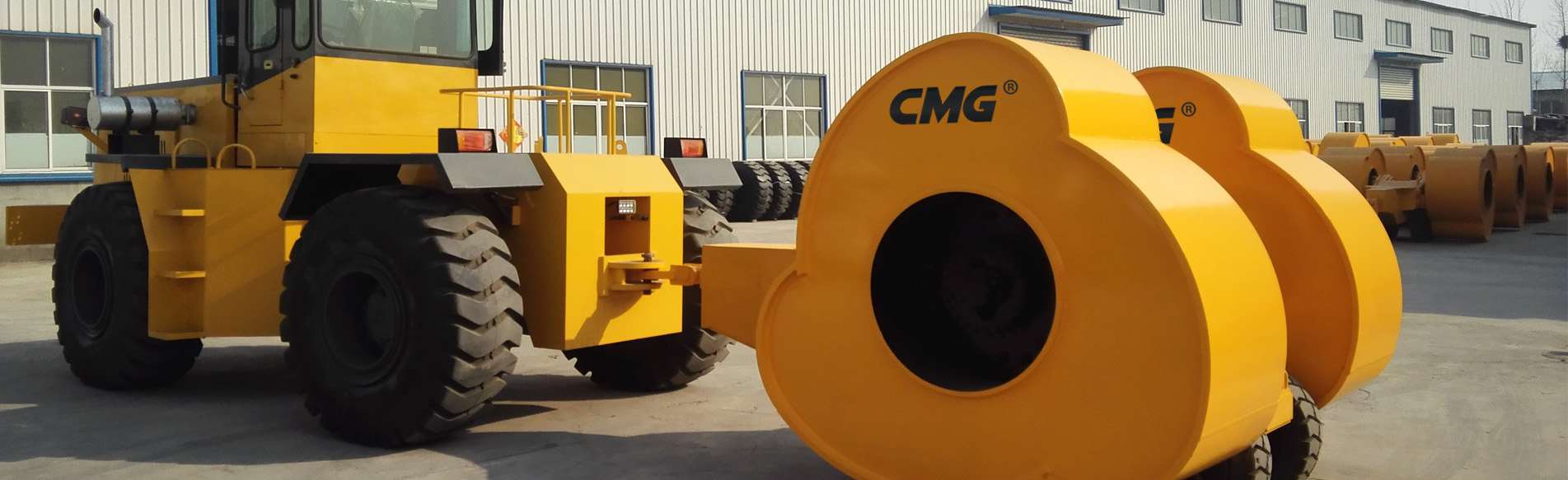
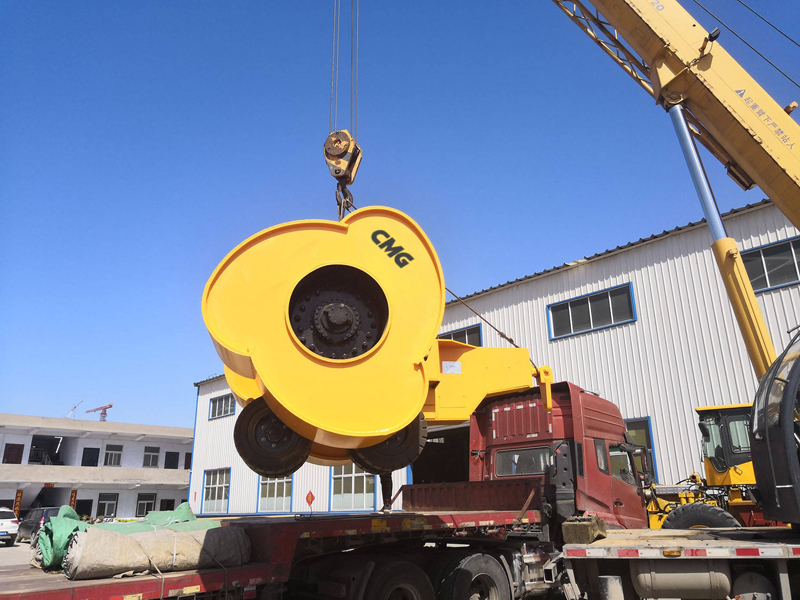
An impact roller looks like a roller and is towed like a roller, but it does not compact the way a roller does. A circular drum holds a constant height above the ground and presses with its static weight, plus vibration if the machine is a vibratory roller. A polygonal drum does something different: it raises its own mass as it turns over a corner, then lets that mass fall onto the flat below. The work is done by a falling blow, not by a rolling press.
The drum is a polygon, not a wheel
Take a three-sided drum. Standing on a corner, its centre sits at the circumradius R above the ground. As it rolls forward onto a face, the centre drops to the apothem — the perpendicular distance from the centre to a face — and the drum lands flat. The height it falls through is the difference between those two radii. For a regular polygon of n sides that difference is:
h = R (1 − cos(180°/n))
This is pure geometry, and it explains most of what an impact roller does. More sides mean a smaller step from corner to face, a shorter fall and a gentler blow. Fewer sides mean a bigger step and a harder one. The same formula explains why an impact drum cannot be treated as a heavy smooth wheel: it is deliberately built out of round.
Where the quoted energy figure comes from
The impact energy quoted for a machine — 25 kJ, 30 kJ, 32 kJ, 35 kJ in the classes built by CMG — is normally calculated as drum mass times g times that fall height. It is a nominal, calculated value for a new drum at nominal mass. It is not a measurement of the energy that actually enters the soil: some is absorbed in drum and shell flexure, some in bearing friction, some is lost to slip, and the ground itself deforms. Treat the figure as a class label for comparing drums of similar geometry, not as a guaranteed input to a geotechnical calculation.
What the blow does to the ground
A blow arrives over a few milliseconds across a contact patch much smaller than the drum face. That produces a high contact stress and a stress wave that travels down and outward from the contact. In a fill with air voids the practical effects are: voids collapse, particles rearrange into denser packing, and the upper layer is sheared and kneaded. The result is a reduction in void ratio at depth and, in a compressible fill, a substantial part of the settlement that would otherwise have appeared later under the structure.
How deep that reaches is not a property of the machine alone. It depends on the soil type, stiffness and moisture, the thickness of the layer being treated, the number of passes, and whether energy is being wasted at the surface. That is why a responsible supplier will not give one fixed depth figure for a drum class. Any single number quoted without soil conditions is a best case from a particular site, not a design value.
Speed, blow rate and slip
Each revolution delivers one blow per side, so a three-sided drum gives three blows per revolution and a five-sided drum gives five. In one revolution the drum advances roughly one circumference, so blow frequency rises with the number of sides and with tow speed, and falls as the drum gets larger. The tractor therefore sets the blow rate; the drum sets the size of each blow.
Two things go wrong when speed is managed badly. Too slow, and the drum rocks on a corner instead of delivering a clean fall; the surface is polished rather than compacted. Too fast for the ground, and the drum skips and slides, wearing the surface and losing energy sideways. On soft or loose fill the first passes are usually run slower until a working crust forms.
Surface finish is a separate operation
Impact compaction leaves a kneaded, cracked and uneven surface. That is the visible sign that energy has been delivered, not a defect. It is also not a finished running surface. Where the treated layer is a subgrade that will carry pavement, the top portion still has to be shaped, moisture-conditioned and compacted with a conventional roller to meet the layer specification. Impact rolling prepares the ground; it does not replace the layer works.
Where the method stops
The same blow that densifies fill also sends vibration into anything buried or adjacent. Buried services, retaining walls, bridge abutments, recently installed piles and nearby buildings all need to be located and assessed before a drum is let loose on the fill. On very soft ground the drum can penetrate instead of compact, and on saturated cohesive soil the blows can pump water and damage the structure rather than densify it. These are engineering limits, not machine faults.
Inputs we ask for before recommending a drum
- Fill type and source, with any trial data you already have
- Layer thickness you intend to place and treat
- Target depth of improvement, or the acceptance test that defines it
- Tractor available: model, power and hitch
- Site constraints: services, structures, vibration limits
- Programme: area to be treated and time available