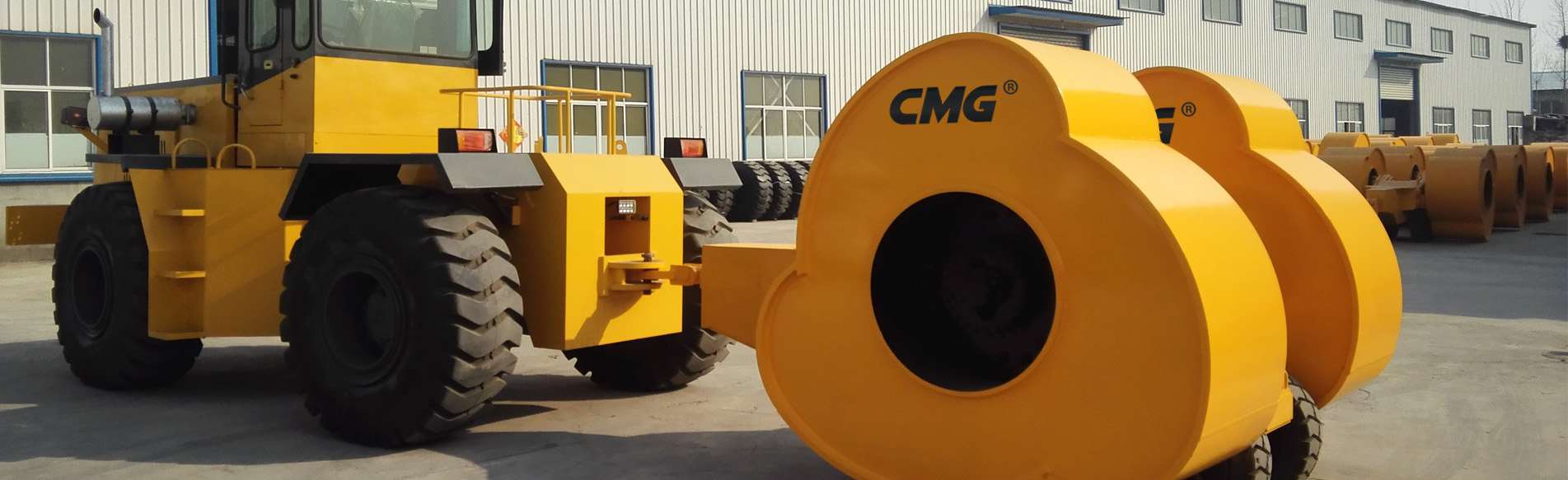
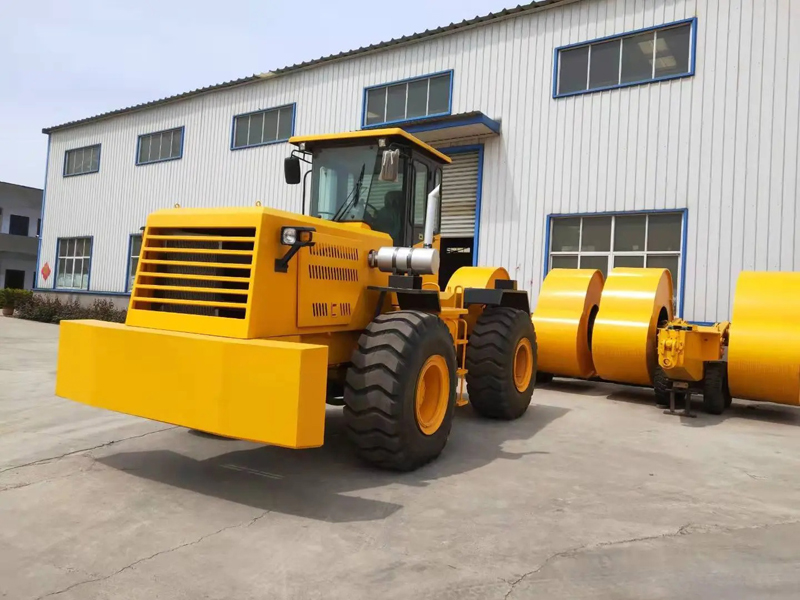
A towed impact roller does nothing on its own. It is a non-circular drum on an axle, hitched behind a tractor, and the pair only works when the tractor can hold the drum at working speed across the fill. Buyers who compare drums alone, then look for a tractor afterwards, are the ones who end up with a 35 kJ drum that cannot be pulled through wet clay.
What the published tractor data covers
Two tractors appear in our listings, both with SINOTRUK engines and articulated steering. The figures below are the ones published on the product pages; they are working data for the standard configuration, and the final arrangement — hitch, ballast, tyres and guarding — is confirmed on the quotation drawing.
| SD320 | SD380 | |
|---|---|---|
| Operating weight | 14,000 kg | 16,000 kg |
| Rated power | 175 kW | 266 kW |
| Engine | SINOTRUK, model stated on the build sheet | |
| Overall dimensions (L × W × H) | 6,110 × 2,820 × 3,350 mm | 5,975 × 2,750 × 3,320 mm |
| Wheelbase | 3,000 mm | 3,000 mm |
| Min. ground clearance | 460 mm | 360 mm |
| Turning radius (outside) | 6,000 mm | 5,800 mm |
| Fuel tank | 330 L | 444 L |
| Traction force (I / II) | 126 kN / 106 kN | 126 kN / 106 kN |
| Travel speed (I / II / III) | 0–8.4 / 0–15.2 / 0–29 km/h | 0–8.4 / 0–15.2 / 0–29 km/h |
| Reverse speed | 0–10 km/h | 0–10 km/h |
| Gradeability | 6% towing / 60% solo | 6% towing / 60% solo |
| Tyre size | 23.5-25-16PR | 23.5-25-16PR |
Drum designations in the sets
Three towed drums carry the set listings: 6825 at 25 kJ, 6830 at 30 kJ and 6832 at 32 kJ, all three-sided. The drum designation is fixed by drum mass and polygon geometry, so the class belongs to the drum rather than to the tractor. Where a listing shows a set such as SD320 with SD30T, the drum is the SD30T and the tractor is the SD320; the pair is quoted together so that the hitch, the tow speed and the transport arrangement are settled at the same time.
Published drum sheets
The three drums that carry the SD set listings are built on the same three-sided pattern, so the difference between them is mass, blow size and the tractor needed to hold working speed. The figures are the published drum values; weight ranges on the SL drums reflect the drum options fitted.
| SD25T | SD30T | SD32T | |
|---|---|---|---|
| Impact energy | 25 kJ | 30 kJ | 32 kJ |
| Drum shape | 3-sided | 3-sided | 3-sided |
| Operating weight | 11,600 kg | 16,000 kg | 16,500 kg |
| Working speed | 10 – 15 km/h | 10 – 15 km/h | 10 – 15 km/h |
| Gradeability | 25° | 25° | 25° |
| Compaction achieved | 95 – 98% | 95 – 98% | 95 – 98% |
| Min. turning radius | 6,000 mm | 6,000 mm | 6,000 mm |
| Overall dimensions (L × W × H) | 3,840 × 2,980 × 2,200 mm | 3,820 × 2,980 × 2,360 mm | 3,880 × 2,980 × 2,480 mm |
| Tread | 1,180 mm | 1,180 mm | 1,180 mm |
| Drum width | 900 mm | 900 mm | 900 mm |
| Damping | Hydraulic, nitrogen, spring and rubber buffers, 14 × 2 × 3 shock absorbers | ||
| Accumulator pressure | 3 – 4.5 MPa | ||
| Tyre pressure | 0.6 – 0.8 MPa | ||
The SL drums sit outside the SD set listings and are quoted with the 35 kJ and 32 kJ complete sets: SL35T at 35 kJ, 14.5 – 18 t, 3,880 × 2,960 × 2,580 mm; SL32T at 32 kJ, 13.6 – 16.5 t, 3,880 × 2,960 × 2,450 mm. Both run a 1,160 mm tread with the same 900 mm drum width.
How the pair is matched
Speed on the fill. The drum only delivers blows if it keeps rolling. On loose granular fill the tractor has power to spare; on wet clay or hauled fill with a soft surface, the same drum can bog the tractor down and the effective blow count collapses. Tractor power is therefore checked against the worst fill on the site, not the best.
Hitch and drawbar. The hitch takes the whole tow load plus the shock of every blow. A drum bought for one tractor and hitched to another needs the drawbar and safety chain checked before the first pass, not after.
Ballast and axle load. Adding ballast helps traction but loads the axle and the tyres. The tractor page figures assume the standard configuration; if the site needs extra ballast, say so at quotation so the axle rating is checked.
Transport. A set moves as two loads or one, depending on drum width and tractor width. On scattered plots, whether the drum can travel on its own axle behind the tractor decides a large part of the mobilisation cost.
What to send us
Fill type and source, the layer thickness you place, the depth the design requires, the worst ground condition the tractor will cross, the site access and the number of separate plots. With those, the set can be quoted as a working pair rather than two catalogue items. Without them, every supplier will quote the same default and the comparison tells you nothing.
What we need to quote a set
- Fill type, source and any trial-section data
- Layer thickness and required depth of improvement
- Worst ground condition on the haul and the fill
- Hitch type on any existing tractor
- Transport between plots and to site
- Acceptance test and frequency