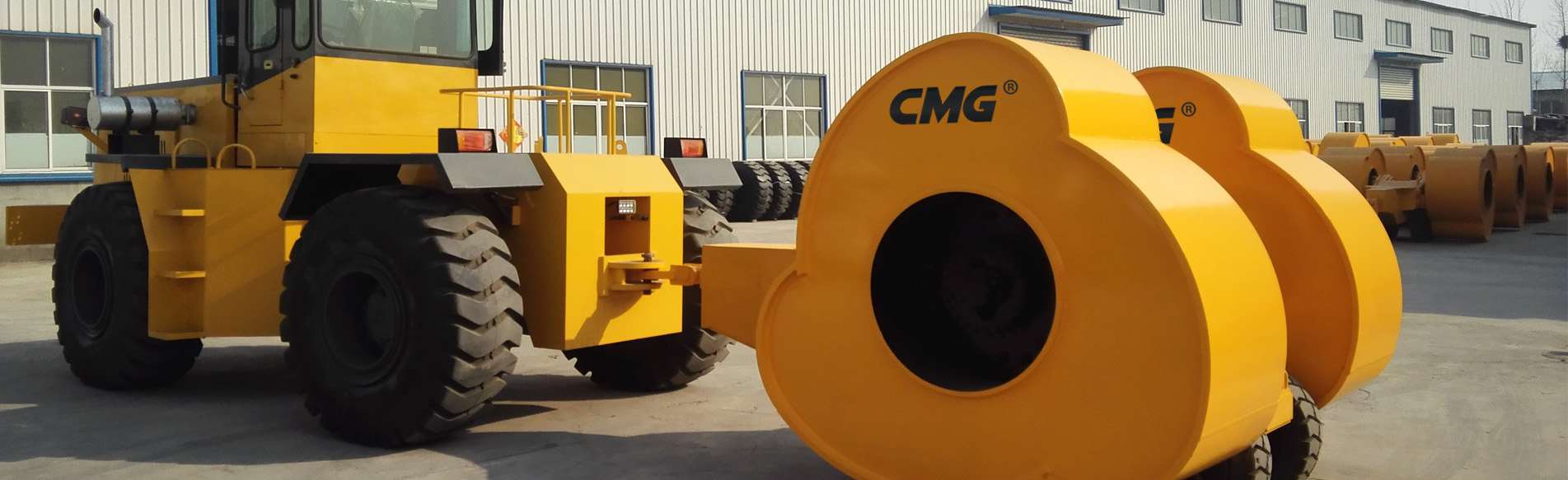
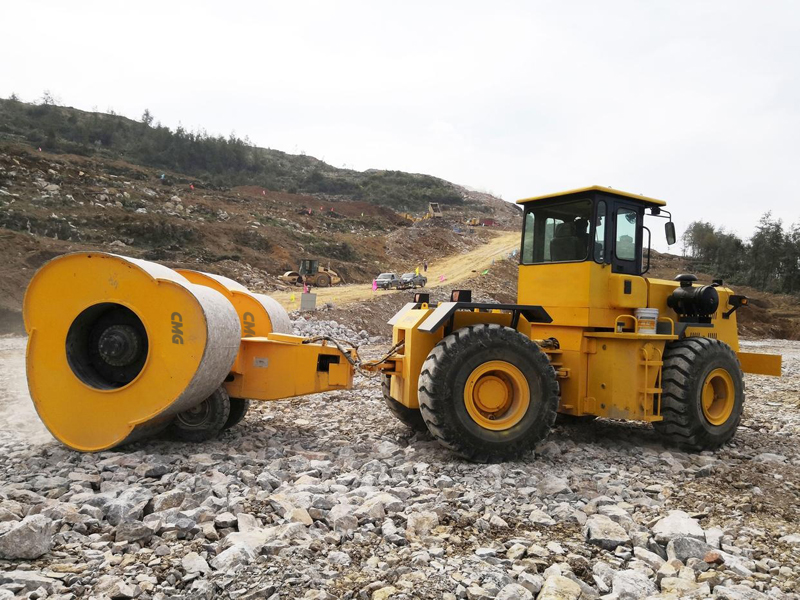
Rockfill is the case where a smooth-drum roller is least useful and a towed impact drum is most useful. The fill is coarse, the particles are angular, and the voids between them are what has to be closed. A vibratory roller of practical weight works the surface and leaves the interior of the layer largely as it was placed.
Why the method suits rockfill
An impact roller delivers its energy as a sequence of blows through a polygonal drum, so the surface is struck rather than pressed. On rockfill that produces rearrangement of the particles and collapse of voids below the surface, which is the mechanism the method is chosen for. It also tolerates the rough surface better than a steel drum, and it covers a large area at working speed — important when the fill volume is measured in hundreds of thousands of cubic metres.
Layer thickness and the trial
The lift thickness a rockfill specification allows is usually much greater than for soil, and the drum has to be matched to it: too thick and the blows only rearrange the top of the layer; too thin and the drum is wasting energy on already dense material. The match is settled on a trial area with the survey and settlement plates in place, not from a table. Published depth figures for the 25–35 kJ class describe favourable fill and are not a substitute for that trial.
Dam embankments
On an embankment dam the fill is placed in zones, each with its own material and compaction requirement, and the acceptance testing is usually governed by the dam engineer's specification with its own frequency and methods. Impact rolling may be used within a zone where the material and thickness suit it; it is not a universal replacement for the specified roller, and the zoning drawings govern. Settlement monitoring during and after construction is part of the design, and rolling records feed into it.
Oversize and segregation
Rockfill segregates. Placing in thin layers from a high tip, or pushing fill down a slope with a dozer, leaves pockets of fine material and open coarse material side by side. Rolling cannot fix a segregated layer; the placement method has to. Where oversize lumps are present, the specification normally controls the maximum size and how it is broken down, and the drum is chosen after that, not before.
What to record
Pass pattern, speed, number of passes per strip, layer thickness at each strip, moisture or water addition, and the survey and settlement readings. On a dam these records are part of the quality file; on a road they are what lets you defend the method if a soft spot appears later.
What we need to quote this application
- Maximum particle size and the specified lift thickness
- Rock type, grading and how the fill is placed
- Zone drawings and the compaction requirement per zone
- Trial area location and the tests to be run on it
- Settlement monitoring arrangement
- Access for a towed drum, or the case for a carrier-mounted unit